CPR Takes to the Web As ADR Continues in the Face of the Coronavirus Crisis

By Anne Muenchinger, Federica Romanelli & Michael Hotz

CPR on Monday hosted an online event, ADR in the Time of COVID-19: How Neutrals & Advocates Can Use Zoom for Mediations & Arbitrations, a 90-minute training dedicated to helping neutrals and advocates use the Zoom Professional online meeting platform, and how to integrate online tools into alternative dispute resolution practices.

Chicago-based attorney Thomas Valenti, an arbitrator and mediator who heads his own firm, and is a member of CPR’s Panels of Distinguished Neutrals, conducted the session.  Held via the platform he was discussing, Valenti showed more than 200 participants the ins and outs of Zoom Professional and how to adapt it for ADR-centric tools such as preliminary hearings, screening arbitration expert witnesses, and private party-mediator caucuses during interparty negotiations.

Monday’s lunchtime session was a follow-up to a March 17 online CPR Institute Mediation Committee where committee members, including Valenti, compared online platforms and electronic mediation techniques.

Details of both sessions are below, as well as information about an American Bar Association online ADR program held last week.

* * *

At the March 30 program, Valenti led a discussion centered around security issues, a key concern for neutrals in using online tools.  Valenti explained the many Zoom features that control access to information, including “end-to-end encryption” of meetings; identification processes; password protection for meetings; waiting rooms that control meeting attendance; the ability to lock meeting rooms once all parties are present, and auditory signals when someone enters or leaves the room.

Valenti discussed essential resources for guidance in the process of moving to an online forum, including  the ICCA-NYC Bar-CPR Protocol on Cybersecurity in International Arbitration, which provides a framework for information security measures for individual arbitration matters. He also noted Zoom’s own white paper and documents on the subject.

Valenti strongly advised using the Protocol’s Schedule A, which contains a “Baseline Security Measures” checklist and provides neutrals with the right questions about their online practice. The spirit of the Protocol, he said, is to offer a framework within which neutrals can make decisions and best adjust online tools to their individual practices and client needs.

Valenti noted the CPR Institute’s participation in the Protocol’s construction by its Working Group. CPR representatives included Senior Vice President Olivier P. André, along with Hagit Elul of Hughes Hubbard & Reed, and Micaela R.H. McMurrough, Covington & Burling, both New York-based partners at their respective firms.

Several Zoom features were explained and demonstrated, including breakout rooms, which can be used for private meetings and caucuses; screen sharing and white boards, which allow for information display or form filling on the spot, and document annotation by all attendees.

A recording of the session will be available soon on the CPR Institute’s new website Resources coronavirus clearinghouse page, ADR in the Time of COVID-19.

Valenti warned that users must recognize the potential shortcomings of online ADR. The assessment of body language will be limited, and there are no guarantees that there is no one sitting off camera or that the meeting is not being recorded.

Meeting participant Dean Burrell, of Morristown, N.J.’s Burrell Dispute Resolution, suggested a tactic he uses to deal with potential issues: He said he asks the parties to scan the room every so often to confirm no one else is present.

Another concern often raised is whether the session is being recorded; Valenti pointed out, however, that this concern is similar to any other mediation or arbitration with the use of smartphones. Hosts should acknowledge that the process is not perfect, but that risks can be minimized.  He said hosts should ask participants if someone else is in the room and not to record the session.

But beyond the  COVID-19 crisis, online ADR practice provides a useful tool for reducing costs and improving efficiency.

For arbitrators, online tools such as Zoom can help them stand out among tech-averse peers, and market themselves as having the ability to continue to push matters forward.

For mediators, online tools should be an addition to an experienced mediator’s set of skills, and can easily be used to set up documents, type in agendas, and set goals during a session. Hosts can also pass control to another party, and use different colors to identify each participant.

Valenti’s demonstration featured a video with Giuseppe Leone, founder of Virtual Mediation Lab, and showed that online mediation is not a new phenomenon. But the COVID-19 crisis is providing the ADR world with an opportunity to move itself forward with technology—not just as a substitute, but as a way to improve its practices.

Valenti recommended that the session host prepare all necessary documents beforehand and have them available on the host computer before beginning the online session, ready for display and sharing. Additionally, mediators should be more conscious about time when conducting an online, as the experience initially will be different from one in a physical space.

Hosts should also be conscious of the level of skill and familiarity that parties and counsel have with these online tools.

Valenti suggested using the initial pre-hearing conference, as set out under CPR Institute Administered Arbitration Rule 9.3, and in the 2019 CPR Rules for Administered Arbitration of International Disputes as an opportunity to test each participant’s level of comfort.

So an easy way to introduce online tools is to switch from a phone call to a video conference for the initial prehearing.

* * *

The genesis of Monday’s CPR members and neutrals-only Zoom training was CPR’s March 17th Mediation Committee meeting.

The Mediation Committee meeting featured two speakers–Kathleen Scanlon, Chief Circuit Mediator for the Second U.S. Circuit Court of Appeals in New York, and James South, Managing Director, Senior Consultant and Mediator for the Center for Effective Dispute Resolution (CEDR) in London—who presented their perspectives on a variety of mediation issues, including a comparative look at mediation practices on either side of the Atlantic, before focusing on mediating during the coronavirus pandemic.

The Committee then heard how CAMP (the Second Circuit’s mediation and settlement program), CEDR, CPR and the New York District office of the Equal Employment Opportunity Commission are dealing with mediations through the COVID-19 pandemic.

Kathleen Scanlon began by discussing the benefits of Sonexis (see sonexis.com) as a conferencing system.  She explained that it delegates pin numbers to each participant and allows the mediator to create private rooms for each party and join them as needed. Parties can then notify the mediator when they want to talk with the mediator.

She said there hasn’t been too much difference, anecdotally, between the success rates of mediating in person and with teleconference. Still, the video/audio approach leads to more accidental interruptions. It also decreases the ability to read body language, which can affect trust. The teleconference process also can be more tiring for the mediator to manage.

CEDR’s James South then stated that he uses Zoom.  Meeting participant Thomas Valenti agreed, also recommending the business version of Zoom to conduct more complicated mediations—which prompted the Monday, March 30 session he led, discussed above.

The Mediation Committee meeting participants, who like the March 30 session also participated by Zoom, agreed that it is critical that the conferencing technology used complies with privacy and confidentiality rules like Europe’s General Data Protection Regulation (best known as the GDPR). It also was recommended that the parties should consult the ICCA-NYC Bar-CPR Cybersecurity protocol.

James South noted that many mediations had been going on normally during the early stages of the coronavirus pandemic, but that he expected that to change over time. He said he has found that parties have been flexible, and been willing to move to video conferencing. He noted that he is unsure if this will survive the crisis, or is only due to the current state of affairs.

South, however, was confident that any reduction in mediation will return to normal levels.

* * *

Committee members then had a lengthy discussion of the issues surrounding the health crisis.  CPR Institute Senior Vice President Helena Tavares Erickson commented that she had provided to members of CPR’s Panels of Distinguished Neutrals a list of services that they could use to mediate effectively during the crisis.

Erickson noted that CPR Dispute Resolution Services offers its neutrals the option of using a secure document exchange, which allows for online text chat in different chat rooms. (For CPR Institute Dispute Resolution filing details, see www.cpradr.org/dispute-resolution-services/file-a-case.)

Meeting participant David Reinman, who is supervisory ADR coordinator of the New York District’s U.S. Equal Employment Opportunity Commission office, reported that his unit has a program that is currently handling all mediation by video or phone. The EEOC also is allowing parties to reschedule if they insist on in-person mediation. Parties who need translators or other special accommodations may invoke applicable proceedings, too.

Tom Valenti asked about screening procedures when conducting in-person mediations. It was noted that many law firms are forcing people to sign waivers stating that they hadn’t been in at-risk places. Given current advisories and shutdowns, however, it’s unclear that such waivers are effective. If parties want to continue doing face-to-face mediation—which has ceased entirely in many shutdown locations for the duration of the emergency–best practice would be to state that they haven’t been in contact with anyone who is infected.

Meeting participants noted, however, such mandatory declarations on disclosing other parties’ infection status could potentially violate HIPAA rules.

Various other online platforms and training options were compared among the participants near the meeting’s conclusion.

* * *

Beyond CPR’s online training event and meeting, and the resources noted, including the new CPR Institute website Resources clearinghouse page, ADR in the Time of COVID-19, others in the legal world and the dispute resolution community have tackled the move online.

For example, the American Bar Association webcasted a panel of experts on continuing with mediations, arbitrations and similar ADR commitments while coping with coronavirus.

The 90-minute March 20 web panel, “ODR in the ERA of COVID-19: Experts Answer Your Questions,” featured panelists including Hamline-Mitchell School of Law Prof. David Larson; online dispute resolution pioneer Colin Rule, who is a Stanford Law School lecturer, and University of Missouri School of Law Prof. Amy Schmitz. It also was hosted on Zoom.

The panelists shared a presentation while providing useful links on a side chat and taking Q&A from the attendees on another window—an electronic version of social distancing that has been repeated, and is rapidly become an ADR standard operating procedure.

The panel provided a list of advice for neutrals wanting to add tech tools to their toolbox.  It focused on accessibility; preparing lists; ensuring a competent approach; accessing live assistance as needed; analyzing online providers (see, e.g., http://odr.info/provider-list/); taking stock of the role for non-verbal communication; assessing whether the disputants will communicate synchronously; confidentiality; considerations for designing an ODR system; ensuring fairness; and ethical considerations.

The ABA panel concluded on ODR resources, providing the following links:

  • Cyberweek 2019; the NCTDR hosts Cyberweek annually at its website.
  • com, a collaborative resource guide.
  • Amy J. Schmitz and Colin Rule, The New Handshake: Where We Are Now (June 27, 2017). International Journal of Online Dispute Resolution 2016 (3) 2; University of Missouri School of Law Legal Studies Research Paper No. 2017-18. Available at SSRN: https://ssrn.com/abstract=2991821

* * *

Muenchinger is a CPR Institute Spring 2020 intern, and an LLM student at the Benjamin N. Cardozo School of Law at Yeshiva University in New York City, focused on the March 30 session discussed in this article.  The section on the CPR Mediation Committee meeting was prepared by CPR Institute Spring 2020 intern Michael Hotz. The section on the ABA seminar was prepared by CPR Institute Spring 2020 intern Federica Romanelli. Alternatives’ editor Russ Bleemer assisted with the research and writing.


A Report on the CPR European Congress on Business Dispute Management (Part II)

EU flagBy Vanessa Alarcón Duvanel

This is the third post of a new CPR Speaks feature, “The European View,” offering valuable insights and perspectives from CPR’s European Advisory Board (EAB).

On 31 May 2018, CPR held its annual European Congress on Business Dispute Management in London. Organized by CPR’s European Advisory Board (the “EAB”) and kindly hosted by SwissRe in the incredible Gherkin building, the event convened European and American practitioners for a successful day of discussion led by four interesting panels. 

This blog piece reports on two panel discussions that took place in the afternoon of the European Congress on Business Dispute Management on 31 May 2018 in London, in the Gherkin Building, kindly hosted by SwissRe.

The afternoon session started with the keynote address of MasterCard Europe President Javier Perez who shared with the audience the important role of ADR in MasterCard’s business worldwide. In a thought-provoking speech, Mr. Perez emphasized MasterCard’s partnership approach with its clients according to which MasterCard does not initiate disputes (litigation or arbitration) against its clients, and rather uses ADR as a means to save the trust relationship.

Climate change and ADR

Moderated by Daniel Schimmel (CPR EAB member, Foley Hoag), the first panel of the European Congress’ afternoon session had four speakers: Kate Cook (Matrix Chambers); Dr. Karl Mackie CBE (CEDR); Nicola Peart (Three Crowns LLP); and Peter Stewart (Interfax Global Energy). Starting from the 2015 Paris Agreement, the panelists discussed how climate change may affect ADR.

The 2015 Paris Agreement signals a significant change and represents concrete actions and timeframes to reduce emissions and adapt to the impact of climate change. It contains strong procedural rules and verification obligations and tells States what to do in respect to climate change. Things have evolved in recent years and changes have been implemented. All States recognize nonetheless that there is a significant gap between where we are and where we should be.

Almost everything in the Paris Agreement is measurable: one can establish whether water is clean/cleaner, what the average temperature is, the number of miscarriages, etc.  Liability can be disputed. Climate change matters are therefore likely to generate disputes and ADR processes. Below are a couple of scenarios mentioned by the panelists:

  1. The risk of investment-treaty claims. Under the Paris Agreement, States must each year implement measures towards the overall long-term objective of stabilization of the temperature; also known as the 2o C global temperature target. The means to maintain the average temperature increase well below 2o C are multiple and include, g., low carbon, no carbon, renewable energyand new building standards.

    These measures and changes in legislation may affect investments and lead to investment treaty claims by foreign investors. The measures may also create incentives for foreign investment such as when a State implements incentives on renewable energy. The arrival of foreign renewable energy firms may not please everyone and if the State subsequently takes a step back and imposes a moratorium on foreign investment, this policy change may constitute a breach of the doctrine of legitimate expectations and lead to a fair and equitable treatment claim by the foreign investor (subject to an applicable treaty). This was the case in the NAFTA case Windstream Energy LLC v. Government of Canada (PCA Case No. 2013-22, 27 September 2016).

  2. New contracts with ADR clauses. The obligations imposed upon States by the Paris Agreement and the 1997 Kyoto Protocol have led to new contracts, many of which contain ADR clauses. One example of this is an international emission system developed under the Kyoto Protocol, whereby parties that exceeded their emission reduction commitments may sell the excess so-called “assigned amount units” (AAUs). Disputes arising out of this system are resolved by arbitration under the Permanent Court of Arbitration (PCA)’s Optional Rules for Arbitration of Disputes Relating to the Environment and/or Natural Resources (“Environmental Rules”).[1] For example, a dispute could arise in respect to a carbon emission registered project if, after the investor has invested, it turns out that the carbon credit was miscalculated, which could affect the value of the investment.
  3. Investment funds. Several investment funds are dedicated to climate change, including the Green Climate Fund (GCF). States, corporations and individuals who contribute to such a ‘green planet’ fund sign a contribution agreement with ADR clauses. In turn, the fund enters into contracts for its investments and these transactions contain arbitration clauses.

Data available to the panelists show that not all companies have reacted to climate change in the same manner. The measures required can be important and may give management the feeling that they are losing the agenda. The panelists praised certain companies, including CPR members in the oil & gas industry, for their efforts in lowering emissions from both their own operations as well as from the plants they operate on.

The entire panel agreed that climate-related disputes involve complex issues that ordinary state courts cannot deal with and require a very thoughtful and structured process.  In this context, mediation is here again an efficient solution able to address the specificities of climate-change cases, such as the need for a fast resolution, the political implications, the status of the parties (NGOs, multinationals, government), etc.

Climate change is one of the new fields to watch and learn about, for ADR practitioners.

Complex financing of dispute resolution

The last panel of the day was moderated by Mark McNeil (EAB member, Sherman & Sterling) and composed of two lawyers, Matthew Bate (Winston & Strawn) and Robert Wheal (White & Case), along with a representative of litigation finance and funding providers, Leeor Cohen (Burford Capital).

Starting with a short reminder of the origin of disputes financing, the panel then discussed the important aspects to consider when working with third party funders, the advantages and downsides of financing of claims, the impact on arbitration and the concept of portfolios of claims.

Initially, ADR financing was developed for parties who could afford the costs of “access to justice.” The concept has evolved and increased in many respects and all claimants now have the option to consider whether they wish their claim to be funded, insured, or otherwise monetarized. More and more well-financed companies use third party funders who have become a risk management tool, most particularly in so-called fee-shifting jurisdictions where court and arbitrators apply the loser-pays rule.

From the perspective of the lawyer trialing the case, the success of ADR financing depends on the good relationship with the funder; a good collaboration is important to avoid the risk that the funder withdraws its funding.

The rapid expansion of ADR financing testifies to its success. Yet, the panel identified potential downsides and risks associated with third party funding:

  • Financing of ADR is a complex world and the panelists described funding contracts as a “nightmare.” Getting to a funding contract also takes significant time and involves lengthy due diligence, questionnaires and the signing of NDAs. Third party beauty contests quickly multiply the work as funders have different approaches and hence different sets of questions.
  • The use of a party funder often limits the party’s ability to negotiate a settlement. By the time the parties reach a settlement, the funder will have spent money and will often want to be involved and approve any settlement amount. A so-called “waterfall provision,” according to which the funder gets first a portion of any settlement amount and the client receives something only if anything is left, impacts on settlement negotiation.
  • A funder may influence the conduct of the proceedings. Some funding agreements contain language reserving the funder’s right participate in decisions relating to the conduct of the proceedings, including with a right to agree to finance the case only as long as it is satisfied that it is worth pursuing. According to the panelists, this could translate negatively on the conduct of the proceedings and the claim must remain 100% with the claimant.

The financing of claims affects the arbitral proceedings in various ways. Respondents have sought disclosure of third party funding agreements, or applied for security for cost on the ground that the claimant’s need for funding suggests that it will not have the necessary funds to pay the costs of the arbitration if it is ordered to. Claimants have sought in their statement of costs recovery of funding costs, which the panelists confirmed, under most arbitration rules the arbitrators have the power to award.

Finally, the panel discussed the debated concept of portfolios of claims, i.e., the financing of multiple claims together. Under this structure, the funder calculates its return based on the performance of the entire portfolio and not each individual claim. Portfolio financing brings down the cost of financing by grouping several claims of a single claimant; it also secures the availability of financing throughout the proceedings. Several law firms have preferred to stay away from portfolios of claims and favor the financing of claims individually.

***

The European Advisory Board will share the date of 2019 CPR European Congress on Business Dispute Management within the coming months.

_____________________________________

[1]  https://pca-cpa.org/wp-content/uploads/sites/175/2016/01/Optional-Rules-for-Arbitration-of-Disputes-Relating-to-the-Environment-and_or-Natural-Resources.pdf ; see also, for more details: https://pca-cpa.org/en/services/arbitration-services/environmental-dispute-resolution/

Vanessa Alarcon Duvanel is a member of White & Case’s international arbitration group and is based in the firm’s Geneva office. She is also the Secretary of CPR’s European Advisory Board. She can be reached at vanessa.alarcon@whitecase.com.


A Report on the CPR European Congress on Business Dispute Management (Part I)

EU flagBy Vanessa Alarcón Duvanel

This is the second post of a new CPR Speaks feature, “The European View,” offering valuable insights and perspectives from CPR’s European Advisory Board (EAB).

On 31 May 2018, CPR held its annual European Congress on Business Dispute Management in London. Organized by CPR’s European Advisory Board (the “EAB”) and kindly hosted by SwissRe in the incredible Gherkin building, the event convened European and American practitioners for a successful day of discussion led by four interesting panels. 

This blog piece reports on the exchanges and discussions heard at the European Congress.  Summarizing this full day and four panels into one blog article would have deprived the readers of too many insightful views and ideas shared at the Congress. Therefore, we have split this reporting in two parts: a Part I sharing the morning panel sessions, and a Part II covering the afternoon panels.

The event kicked off with welcoming remarks by Maurice Kuitems, (EAB Chair, Fluor Corporation) and Olivier André (CPR), following by Elena Jelmini Cellerini, (EAB Member, SwissRe), and Nicola Parton (Swiss Re). Ms. Parton offered an inspiring message on the role of ADR and the importance of sustainable dispute resolution mechanisms, a goal that requires full respect of transparency principles and responsiveness to issues raised by our counterparts.

Make ADR great again! The in-house counsel’s perspective

Kenneth B. Reisenfeld (BakerHostetler) moderated the first panel of the day, which was exclusively composed of in-house counsels: James Cowan (CPR EAB Member, Shell International Ltd); Noah J. Hanft (CPR); Isabelle Robinet-Muguet (EAB Vice-Chair, Orange); and Gill Mansfield (Media Law Services).

The first question put to the panelists was whether there was a past renaissance about ADR, or has the ADR process gotten off track. The industry has come a long way since its early years. Many concepts have developed and there are now growing concerns that arbitration is not fulfilling its promises of being fast, confidential and efficient. These criticisms are legitimate and impossible to ignore in light of the high costs and duration of certain arbitral proceedings or the inclusion of U.S.-style disclosures in arbitral proceedings.

There is consequently a real need to make ADR great again, and to find business solutions to business disputes. The panel shared the in-house perspective on some of the means to improve the ADR process:

  1. Involving the business people

All speakers agreed that involving their colleagues from the “business side” is certainly not an easy step, yet it is important and a critical task of the legal department. When a dispute arises, the company’s business does not freeze and the project team has little time to devote to a dispute. The business team’s approach to the dispute will be different from that of the litigators and their early involvement can help define the ADR process in a more business sensitive manner, as opposed to a pure litigation proceeding.

Achieving adequate collaboration from the business people in a dispute requires a cultural environment sensitive to ADR and its benefits. This is only possible with sufficient trainings and an overall commitment of the management to ADR.  As the panelists phrased it several times, the business people must be able to understand the “importance of taking ownership of the matter.”

  1. Early case assessment (ECA)

For the panel, an early case assessment (ECA) is a critical element to any dispute resolution mechanism. It should be the first step in any dispute and is fundamental to understanding the business needs. A good ECA will serve in many ways: it will help shape the ADR process; guide the relationship with outside counsel; and highlight the skills and expertise to look for in the designation of a mediator or arbitrator, or in the selection of experts.

  1. Mediation

According to the panel, using mediation and appointing a commercially minded neutral can improve the efficiency of the dispute resolution mechanism. The financial savings can be significant, particularly in cases where the appointment of a neutral with relevant skills allows the parties to negotiate entirely (or partially) without having to involve outside counsel.

  1. Multi-tier / Step dispute resolution clauses

The speakers briefly touched upon multi-tier dispute resolution clauses, whereby in case of a dispute the parties undertake to take certain steps prior to commencing arbitration in an attempt to amicably settle the dispute. Some of the panelists view such clauses as a thoughtful way of bringing mediation into the process early, and a means to facilitate the involvement of the business people. Other panelists do not consider mandatory mediation as an efficient tool. Every dispute is different and settlement negotiations and/or mediation may sometimes be more appropriate at a later stage. An ADR-friendly corporate culture should also render multi-tier clauses unnecessary.

  1. Diversity

All panelists concurred that a lot of work has been done but so much remains to be accomplished in order to bring more diversity to the ADR process—particularly with respect to age and geographical location. From the panel’s perspective, the in-house counsels have a central role to play in this issue. They can, for example, ask the lawyers to “dig deeper” and present new names on the list of arbitrators, to encourage new appointments, which in turn will contribute to broadening the existing pool of experienced arbitrators for large and complex commercial disputes and will consequently increase the efficiency of arbitral proceedings.

The Progress and impact of the European Directive on mediation: Where do we stand and what’s next?

The panel was composed of mediation experts from various European horizons: Alexander Oddy (EAB Member, Herbert Smith Freehills) who served as moderator; Vanja Bilić, PhD (Ministry of Justice of the Republic of Croatia); Professor Pablo Cortés (Leicester Law School, University of Leicester; Martin Brink, PhD (Van Benthem & Keulen); Ivana Gabrić (Končar – Electrical Industry, Inc.); and Tsisana Shamlikashvili (President, Russian National organization of Mediators, Founder of the Center for Mediation and Law, Head of Federal Institute of Mediation).

The European Union has enacted two “mediation” directives, namely: (1) the “European Directive 2005/52/EC on the facilitation and access to ADR and the promotion of amicable settlement” (the “EU Directive on mediation”), following which some member States have amended their domestic rules to impose mediation prior to litigation; and (2) the “Directive 2013/11/EU of the European Parliament and of the Council of 21 May 2013 on alternative dispute resolution for consumer disputes” (the “Consumer Directive on ADR”) which imposes mandatory mediation to all businesses with consumers.

The panelists extended the scope of their discussion beyond its title and the impact of the EU Directive on mediation to include private initiatives taken by corporations to impose mandatory mediation, independently from legislation.

Both the European Mediation Directive and the Consumer Directive on ADR have had a positive impact on ADR.  There is, however, still room for improvement. As with any major change, it will take time. All speakers agreed that improving the use of mediation requires increasing awareness of the benefits of mediation. The potential to save money and time and to salvage the business relationship is significant with mediation, and users need more knowledge of these advantages. One avenue mentioned by different speakers to raise awareness about mediation consists of allowing the management to witness a mediation proceeding in order to understand concretely how it works and how it deploys its benefits for the company.

Ivana Gabrić shared Končar’s success story of imposing mandatory mediation. In 2005, unrelated to any legislative action, the company decided to introduce a mandatory mediation policy for all of its contracts. Within a few years, the policy led to the elimination of all court litigation. Today, Končar has no pending litigations. In light of the success, the management extended the policy to labor disputes.

The EU Mediation Directive also triggered changes beyond the borders of the EU, such as in Russia where—Tsisana Shamlikashvili reported—mediation represents a big cultural change. In a country where courts are very busy and obtaining a judgment has become part of the ordinary business (regardless of the time it takes and any ability to enforce upon such judgement), introducing mediation is equivalent to changing mentalities and requires significant effort. But, the progress is on-going and the efforts deployed to convince the users of the benefits of mediation are starting to pay off.

Stay tuned for part II reporting on the panels discussing “Climate change and ADR” and “Complex financing of ADR.”


Vanessa Alarcon Duvanel is a member of White & Case’s international arbitration group and is based in the firm’s Geneva office. She is also the Secretary of CPR’s European Advisory Board. She can be reached at vanessa.alarcon@whitecase.com.


How to Tank a Mediation Without Even Trying

By James P.S. Leshaw

LeshawEvery so often, you may want to tank a mediation. Maybe you know in advance it can’t settle. Maybe the blood is so bad between lawyers or clients that you just want to teach a lesson to the other side.  It could be that you think the judge or arbitrator is really enjoying all of the discovery disputes or doesn’t have enough to do. Whatever the reason, based on my experience as a mediator, here are the top ten ways to blow a mediation (as well as some light reading).
  1. Promise your client (preferably in writing) that there is no way he can lose at trial. Also, be sure to under-estimate the cost of the litigation both in terms of the cost of fees and expenses as well as the client’s expected time-commitment and anticipated loss of sleep. This should sufficiently reduce the client’s incentive to settle at mediation.
  2. Do not submit a mediation statement to either the mediator or the other side. The reality is that the mediation statement serves very little purpose other than to educate the mediator and the other side to the strengths of your case. If you do decide to deliver a mediation statement anyway, consider using it as an opportunity to educate the mediator on how unreasonable the other side is (though this should be obvious to any experienced mediator as the other side has not yet caved to your demands). You may also choose to inundate the mediator and other side with copies of pleadings you have already filed in the case, with no explanation as to their relevance.
  3. Do not personally attend the mediation – your attendance might send the message that you are serious about settling. Instead, send a junior associate who has had little or no involvement with the litigation, who does not know the factual or legal issues and who does not have the confidence or trust  of the client. This will help to ensure that the mediation is not successful.
  4. Be efficient when preparing for the mediation (assuming you decide to attend). Do not focus on the law or the facts – the other side must already be familiar with these or be too dense to understand your version of the law or the facts. Focus on the important stuff like making the mediation personal.  Be prepared to embarrass opposing counsel by talking about their procedural gaffes in this case or their losses in other cases. This is really just constructive criticism.
  5. Do not make an opening statement at the mediation – simply state that your position is already clear. Should you decide to make an opening statement, be sure to point out how unreasonable the other side has been for not simply giving in, explain you are not prepared to compromise in any way, but have a “take it or leave it” offer. Also, don’t forget to remind the other side and the mediator that you have scheduled only one hour for the mediation because you need to be back at your office to take a phone call.
  6. Do not bring your client to the mediation. Instead tell the other side that the client is available by telephone or that you already have settlement authority. Should your client inconveniently decide to show up at the mediation, make sure he does not participate in the mediation. You’re being paid to attend the mediation so you should respond to any questions or comments made to your client by the mediator or the other side. This is your case after all.
  7. If your client is the defendant, cry poverty but do not provide any financial information to support the claim.
  8. Do not admit that your case has any weaknesses at all, including in a private session with the mediator. So long as you bury your head in the sand, neither the mediator nor the other side will realize there is a potential chink in your client’s armor.
  9. Yell, scream and pound on the table so everyone in the room knows you really mean what you are saying.
  10. If it looks like the case may settle despite your best efforts, be prepared to pack your bag and leave. The best exit is a dramatic exit.

About Jim Leshaw:

Jim Leshaw is a mediator and arbitrator based in Miami and Key Biscayne, Florida.  He handles a wide variety of commercial disputes throughout the United States, Latin America and Europe.  He also sits on the board of directors of Avianca Holdings, S.A. (NYSE:  AVH), the Latin American based airline. He can be reached at Jim@LeshawLaw.com.

This post originally appeared in Law360, and was republished with permission.

THE MASTER MEDIATORS/ Part I: On Joint Sessions

mastermediators

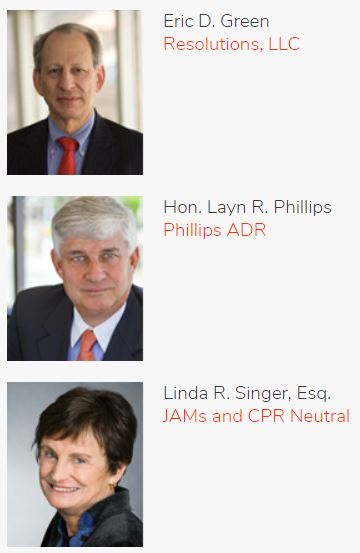
One of the panels at CPR’s recent annual meeting in Atlanta featured three master mediators: Eric D. Green, of Resolutions, LLC; Hon. Layn R. Phillips, Phillips ADR; and Linda R. Singer, Esq., a JAMS and CPR Neutral.

Guided by moderator Jana Litsey, Senior Executive Vice President and General Counsel and Secretary of The Huntington National Bank, our panelists shared views and best practice tips on the ADR process they know so well. This post, the first in a series, will focus on the almost curiously controversial topic of joint sessions.

***

“We call it the disappearing joint session,” said Eric Green. “As all parts of a mediation are potentially valuable, I think the trend away from the joint session is a big loss, reflecting a misunderstanding of its potential and use and value. Of course, there are no rules in mediation except that there are no rules in mediation. Every case is different.”

Green noted that lawyers will typically insist no joint session is needed and would in fact be a waste of time—especially if they have him only for one day—because the case is mature and well known to both sides. While he agreed that those would be potential negatives, he has observed over time that the parties rarely in fact understand each other’s cases. Joint sessions have the potential to begin to close that gap.

“When you think about it,” he explained, “the joint session is your best and last opportunity to speak directly to other side. They are your audience and, to have a successful outcome, you must get them to agree to something you will accept. Assuming the session has been properly prepared—with private telephone calls between you and the mediator ahead of time, and with mediation statements exchanged—this is the start of a day’s worth of negotiation and your chance to get your message across to the other side (hopefully someone with real authority). This is your opportunity to establish a connection, demonstrate that you are prepared to be reasonable if they are, and to address the strongest arguments in the other side’s mediation statement.”

Joint sessions also serve an important purpose for the mediator, Green stressed. “If I need to say something to the other side at 5 p.m., I really want you to have said it at 9 a.m. so I can tie my message back to yours. It gives me a mechanism to deliver what is sometimes tough feedback to the other side by deflecting some of it, which can be very helpful.”

Green cautioned, “This is not an opportunity for you to get some emotional satisfaction by beating up on the other side. So don’t waste your time repeating your strongest points or engaging in threats or bombast. Don’t try to stand up and impress your client. And don’t try to impress the mediator—they are not the judge and jury.”

Green summed up, “No one has ever stood up in joint session, like in Perry Mason, and said, ‘I get it now, I’m guilty. I’ll withdraw my case.’ But it starts the process of people beginning to understand risk and see things from the other side’s perspective.”

Jana

JAMS and CPR Neutral, Linda R. Singer, described what she sees as a clear regional split, with colleagues on the West Coast coming down on the side of never seeming to utilize the joint session process, with East Coast colleagues being much more open to it.

“Some judge mediators are unaccustomed to managing conflict,” Singer surmised. “It makes them nervous.” But she agreed that the joint session process can be a real opportunity. “The hardest thing,” she described, “is when I convene a conference call and they tell me they’ve all agreed and don’t need a joint session, because it’ll take us until after lunch to get back to where we are in the process now, but then at 4 pm in the afternoon we are still saying the same things we were saying at the start of the day.”

Our third panelist, Layn Phillips, of Phillips ADR, was less enthusiastic about joint sessions than his colleagues. He tends to advocate for shared or exchanged mediation briefs and reply submissions, he explained, and holds the view that mediators mainly earn their money in private caucus sessions. But he did agree that there were circumstances (e.g., in some securities cases) where the joint session, or what he likes to call the “targeted session,” is helpful on topics like damages.

“You might have 25-page opening submissions and several reply briefs,” Phillips explained, “but only three paragraphs dealing with damages, so it would not be uncommon for me in this situation to tell the parties I wanted a focused targeted joint session on damages. This may not necessarily be an opening joint session, but one which could take place later in the day.”

Another example might be if a case is very close to trial. Sometimes this can be a helpful reality check for the clients. “Much depends on your client representatives,” Phillips added. “If they are very sophisticated and prepared, and you’re convinced from pre-mediation submissions and calls that they know the case, having them sit there while a very talented trial lawyer takes their case apart is not necessarily helpful.”

“As everyone here knows,” Phillips summed up, “we’ve all been to joint sessions that are incendiary, or that cover ground that is not only well ploughed but well fertilized, so I try to be very focused on when and under what circumstances I recommend this process.”

Eric Green reported also finding joint sessions to be useful when there are complex technical issues, such as those arising in construction, design or financial cases. In fact, while this is unusual, he reported having a joint session last as long as a week in a case involving technical exchanges involving nuclear plants. “If the parties are insisting on a principles-based and merit-based approach to resolution,” he concluded, “joint sessions can provide an opportunity to demonstrate that you’ve heard the merits of the case. Then the parties can start discussing dollar amounts.”

Layn Phillips provided the final word on this topic, noting that it is not uncommon for him to hold joint sessions late in the day, particularly on non-monetary terms. “The last thing you want to do is to have a quiet, dignified search for a number, and then find out that the parties disagree on fundamental terms such as indemnification or non-monetary points that will turn out to have monetary value.”

Stay tuned to CPR Speaks for more tips from our master mediators, and more great content from AM18…


CPR Releases New Mediation Best Practices Guide for In-House Counsel

By Erin Gleason Alvarez and Rick Richardson

As co-chairs of the Mediation Committee, we are pleased to announce the release of the Mediation Best Practices Guide for In-house Counsel: Make Mediation Work for You.  The Guide will be launched as part of the CPR Institute Annual Meeting in Atlanta from March 8 through 10, 2018.

Make Mediation Work for You was inspired by conversations among in-house counsel that have arisen in the Committee.  What is the best way to convince counterparties that mediating early is a good thing?  How do you best prepare for mediation?  Should you always accept a counterparties’ suggestion on the mediator?  What is the best way to keep negotiations going if the mediation concludes without settlement?

The Guide answers all of these questions and includes insider tips from in-house counsel throughout.  Make Mediation Work for You begins with a discussion on when to contemplate mediation and then takes the in-house reader though every step in the process: from convening the process and making negotiations plans before the in-person session to creative solutions for overcoming impasse and structuring a settlement agreement.

Make Mediation Work for You will undoubtedly be a valuable resource for CPR members.  We are grateful to the Mediation Committee members for their efforts in creating this important guide, most notably John Bickerman, David Brodsky, David Burt, Steve Comen, Steve Gilbert, Duncan MacKay, Chris Mason, Judy Meyer, Meef Moh, and Mike Timmons.

We look forward to seeing many of you at the Annual Meeting next week!


Erin Gleason Alvarez and Rick Richardson co-chair the CPR Mediation Committee.  Rick serves as Vice President and Associate General Counsel, Dispute Resolution and Prevention for GSK.  Erin is the former Global Head of ADR Program for AIG; she now has her own mediation and arbitration practice and is a member of the CPR Panel of Distinguished Neutrals

Ethics Issues in Mediation: Confronting the Maze of Confidentiality and Privilege

By Ginsey Varghese

With a rise in litigation about mediation, likely linked to its  increasingly common use, it is important to take a closer look at the ethical issues facing both the mediator and advocate in a mediation.

What are the ethical obligations of mediators to parties when engaged in “shuttle diplomacy” in private caucusing? How does blanket confidentiality in mediation agreements intersect with attorney-client and work product privilege? In disputes following mediation, will courts pierce the confidentiality of mediation? Can mediators be subpoenaed to testify?

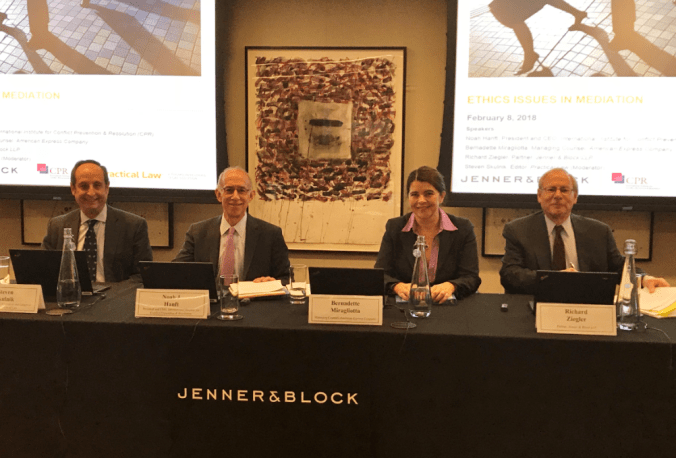
These hairy contours of the law and mediation were addressed in an interactive panel hosted jointly by CPR, Practical Law, and Jenner & Block, LLP on January 8, 2018.  The panel was moderated by Steven Skulnik (Editor) of Practical Law, and featured Noah Hanft (President and CEO) of CPR, Bernadette Miragliotta (Managing Counsel) at American Express Company and Richard Ziegler (Partner) at Jenner & Block, LLP (pictured in the order, from left to right below).

use webinar

Almost 400 people attended the session via webinar, and another several dozen in person at Jenner & Block’s New York offices. The discussion was extremely engaging as the moderator, Mr. Skulnik, steered panelists’ conversations around realistic hypotheticals with live polling and immediate feedback from the audience.

The session began discussing a mediator’s duty of confidentiality in private caucus. Mr. Ziegler stated, “An effective mediator must review with the parties exactly what the mediator can say in caucusing with the other side.” All the panelists agreed, adding that mediators must be tactful in their language conveying information to guard the confidentiality of each side.

In a discussion about whether mediators should suggest specific dollar amounts for offers or demands, Ms. Miragliotta stressed that this should be avoided as it is essential that parties feel like it is their mediation…that they own the process and the settlement. It is not beneficial for parties to feel rushed into an outcome over which they do not feel ownership, she added.

Another important consideration  discussed is that there is no single uniform body of law on mediation across the 50 states jurisdictions and federal jurisdiction, and only 12 jurisdictions have adopted the Uniform Mediation Act.

As Mr. Hanft explained, knowledge on the applicable law or the necessary “magic words” in a particular jurisdiction when enforcing a settlement or protecting confidentiality in a post-mediation dispute is paramount. He also offered practical guidelines to ensure a settlement is more likely to be enforced.

The panelists deliberated a range of other topics: the complexities of Attorney-Client Privilege and Work Product Doctrine in a mediation; post-mediation disputes that commonly arise including settlement enforcement; mediation confidentiality issues in malpractice or non-party disputes; and best practices for mediator and advocates, among others.

As Jenner & Block’s Ziegler summarized, “Confidentiality in mediation is not ironclad.”

The final takeaway? When in mediation, be mindful of not crossing ethical lines and not inadvertently waiving attorney client privilege or work product protection.

An audio stream of the panel discussion is available In CPR’s member’s only Resources Library HERE (you must be logged in to view).

Dispute System Design: Advancing Predictability, Cost Savings and Efficiency In-house

erin
By Erin Gleason Alvarez

The problem with disputes is that they never go away.  Yes, they are resolved one by one – maybe even a group of them are settled at once.  But there are always more lurking: another claim, waiting to be filed; another complaint, making its way to your desk.  It’s a cycle and everyone knows that.

Many things in this dispute world are out of your control – or at least it feels that way.  Litigation costs money – sometimes lots of it.  It takes time – sometimes lots of that too.  Both of these things are hot commodities and less than ideal expenditures from a business perspective.  Thus, the pressure on the in-house attorney to manage risk, manage cost, settle, settle at the right cost at the right time… it’s always there.

If we know that there will most likely always be a disputes cycle, forever costing money and taking precious time, what is the best way to manage this and prevent logjams? There is an answer.

Dispute System Design

Perhaps it makes sense to take a cue from the business side of the house and view this dispute cycle as another business process to be mapped and managed.  At CPR, we’ve heard many stories affirming this strategy as a successful one, including my own experience in-house.

Nonetheless, year after year, in survey after survey – when in-house counsel voice their concerns over cost and efficiency – there is rarely a mention of dispute resolution systems.  For example, in the 2017 Litigation Trends Annual Survey produced by Norton Rose Fulbright, only 9% of corporate counsel reported that internal processes or controls for reducing the volume of litigation was an effective strategy; only 2% favor a regular risk mapping process.  Instead, a majority of corporate counsel responding to the survey rely on regular training programs for lawyers and early case assessment as effective ways to manage litigation.

What if you combine training + early case assessment + risk mapping + protocols?  Picture it: A coordinated system to resolve disputes, designed specifically to address the in-house concerns about spending too much money on litigation and wasting time that might be better spent elsewhere.

This is where “dispute system design” comes in.  Dispute system design is the process for identifying the trends and pain points in your dispute resolution/litigation practice, and then implementing process improvements along with measurements of your success.

How It Works

Here is a brief overview of what a dispute system design strategy entails:

  1. Conduct an assessment:  What’s vexing, trending, anticipated in your disputes portfolio?  This may be identified through surveys, interviews and data analysis.
  2. Process improvement:  What solutions can you identify to address these issues?  How is mediation being used – can it be done earlier?  What negotiation techniques are most relied upon?  How is arbitration handled?  Some cases must inevitably be routed to litigation – what is the best way for identifying them early?
  3. Implementation: How will you implement the strategies you have identified as most sensible for your work?  Training?  Metrics?  Employee evaluation? Changes to law firm relationships? Processes for identifying better mediators and arbitrators?
  4. Measure success: What criteria will you require to determine the level of success achieved?  Are you mainly concerned about saving litigation cost?  Cost associated with employee time? Case volume?  Settlement rate?  Or are there qualitative goals that should be considered as well, including employee job satisfaction and opening more opportunities for career growth?

Areas of Application

Just as systemic approaches to governance, compliance and contract management are well settled  corporate strategies, dispute system design and management is a practical way to manage exposure.  Bespoke litigation strategy will always have some role in the cycle.  But let’s face it:  Are most of your cases unique and deserving of their own individualized strategies and budgets?   Are the facts so  different that the analysis must be carefully tailored, time and again?  Sometimes.  Most of the time – probably not.

A dispute system design approach may be implemented to address your litigation portfolio, formalizing early case assessment measures, monitoring and reporting on their efficacy and helping to trigger other dispute resolution mechanisms where needed (e.g., direct negotiation processes, mediation, streamlined arbitration, etc.).

Dispute system design work may be applied in other contexts as well.  For example, many reports cite in-house concerns over the rise in cybersecurity disputes over the next year.  Analyzing your current cyber disputes portfolio, in order to develop methods for triage and settlement approach is one way to insert some predictability into an area that is causing a fair amount of anxiety in-house.  The same can be said for other areas of growing concern to in-house counsel: rising environmental concerns, the ever-present threat of mass disasters, and continued changes in health care – all of which are stressors on litigation budgets.  It is proactive to address these risks in a systematic way to enhance predictability, efficiency and cost controls.

Do You Need It?

In determining whether dispute system design is right for your organization, consider these factors:

  1. Are you currently satisfied with the length and cost involved in managing disputes?
  2. Have you identified any issues relating to dispute outcomes (in terms of quality, time to resolution, or expense required)?
  3. Are there any obvious issues that you can address to make your processes more efficient?
  4. Do you have the bandwidth or expertise to conduct this type of review for your company?
  5. What is the ROI in retaining someone to conduct the review for you?
  6. Would reporting on dispute resolution savings, or other efficiencies, be of value to the organization?

Conclusion

Dispute system design is an important function for in-house counsel to utilize in managing disputes in a systematic way.  A coordinated approach lends to predictability in dispositions, cost savings and many other efficiencies.


Erin Gleason Alvarez launched Gleason Alvarez ADR in 2017.  She formerly served as the Global Head of ADR Programs at AIG, where she designed dispute resolution systems and served as an advisor to state agencies in the development of mass disaster protocols following Hurricanes Irene, Ike, Sandy and mass claims resulting from wildfires fires in California. 

Erin now serves as a mediator and arbitrator in commercial and insurance disputes.  She also serves as a consultant to corporations and law firms in designing dispute resolution systems. 


“New and Improved New Year’s Resolutions” For Judges, Politicians and Policy-Makers

By Judge Steven I. Platt (Ret.)

steven_125
As the new year approaches, I welcome the opportunity in this space provided by The Daily Record, to reflect on the last almost 11 years since I “retired” as a full-time judge and entered a very different world of Private ADR, consulting, as well as public speaking, lecturing and teaching for diverse organizations. I have also been lucky enough and honored, during that time, to have been approved by the Court of Appeals to be recalled as a Judge and have done so enthusiastically and learned even more with the added perspective of my other work and experience incorporated into my decision making.

That said—and with I hope the proper degree of humility, as well as a recognition that our hopes and dreams should not be born out of naiveté or unrealistic expectations for ourselves, the three branches of government, or, for that matter, the human race—I offer the following, hopefully improved over previous years, based on new experiences and additional perspectives, suggested 2018 New Year’s Resolutions for Judges, Politicians and Policy-Makers:

1 – Don’t refuse to reference reality when you make personal, political, legal, and even medical decisions. You can aid that process by listening and paying attention to people and ideas with which you do not agree, in lieu of reinforcing or restricting your sights and sounds to those pictures and words which reinforce your previously held views.

2 – Don’t even try to defend the indefensible. It won’t work.

3 – Recognize that isolating yourself, your community and even your country—if you are a President, Governor, Legislator, political or community leader, policy-maker, or even a Judge—will not make the complexity of an increasingly complicated world go away. On the contrary, it will make your decision-making progressively more flawed and exponentially more dangerous to you and those affected by your self-inflicted defective judgement.

4 – Recognize that the choices which you desire are usually not the options that reality dictates that you must choose from. Wishing otherwise won’t change that reality.

5 – Don’t insist that “the other side” accept and subscribe to your perception of reality as a pre-condition to further communication, whether that “other side” is competing with you or is attempting to collaborate with you. Better to analyze and address your counterparts’ interests in the context of their reality if you wish to move your idea or process forward.

6 – If you are trying to persuade a third party of the merits or wisdom of your position on an issue—whether that third party is a jury, judge, the voters of a federal, state, or municipal district or the elected or appointed officials put there by the voters to decide your fate or your client’s fate—do not forget or ignore who those person(s) are and the intellectual world they live in. To do so will be fatal to your cause.

7 – Be intellectually curious if it is within your DNA to be so. If it is not, check with the best and the brightest in the medical profession to arrange a transfusion of DNA from a known intellectually curious person. Your life will be much more interesting and fulfilling.

8 – Recognize that there are many “Monuments to Persistence” whose success in whatever professional, business, personal field they chose was, in large part, the result of their persistence. Persistence in the pursuit of a good idea is worth emulating.My favorite illustration of this came from my now deceased friend and mentor, the first Chief Judge of The District Court of Maryland, Robert F. Sweeney, who in an interview upon his retirement, reflected upon what it took to accomplish what Governor Mandel had described as a “gargantuan task” – the creation and implementation of a new Court, The District Court of Maryland.

On May 5, 1971, as he was sworn in as the first Chief Judge and at the time the only Judge of The District Court, Chief Judge Sweeney said “Insofar as I am able, I shall attempt to make this court what the people of Maryland are entitled to have it be: A Court of integrity and a forum in which the personal and the property rights of all citizens can be freely and fairly adjudicated by judges learn in the law—judges who are dedicated to the principle of equal justice under the law for all.”

Upon his retirement, virtually a quarter of a century later, illustrating the wisdom and concomitant success of persistently confronting the reality of a corrupt culture in accomplishing that goal, Chief Judge Sweeney recounted that experience as follows: “There were judges who were racists, who had alcohol problems, who were wife beaters and who thought they had found the greatest 10-2 job in the world. I outlived the bastards. The whole collection of them.”

The moral of this story is obvious. The Monument is the District Court of Maryland!

9 – Share in the optimism of Bernard Baruch, an advisor to four Presidents, about the future based on his faith “in the power of the human mind to cope with the problems of life.” Share in his conclusion after a lifetime of advising Presidents that “To nothing so much as the abandonment of reason does humanity owe its sorrows.” We should therefore heed the warning based on history and experience that our failures as individuals and communities have been, and will be the consequences of “action without thought” which usually follows thoughts unaccompanied and therefore devoid of analysis.

10 – Believe, as did Bernard Baruch, that our society can in fact solve our problems by placing our trust in the unfettered intellect, reason, wisdom, and compassion of smart individuals not in crowds.


I would footnote these updated suggested “New Year’s Resolutions” with the following afterthought based on my continued observations of all three branches of government and the politics, economics and psychology which drives them: The collective blogosphere, talk radio, cable TV, internet and advocacy groups, politicians, and other public figures—whether they claim omniscience, heavenly blessings or other supernatural powers or origins—do not address any reality except their own. That said, let’s try analytics in 2018. We might like it. In any case, Happy New Year!

This post is reprinted with permission from “A Pursuit of Justice,” a blog by Judge Steven I. Platt (Ret.) that focuses on the intersection of law, economics, politics and the development of public policy.  Judge Platt currently owns and operates his own private Alternative Dispute Resolution Company, The Platt Group, Inc. through which several retired judges and experienced practitioners offer mediation, arbitration and neutral case evaluation services to business, governmental agencies and their lawyers mostly in complex litigation and disputes.  Judge Platt’s experience and vocation make him an expert in conflict resolution particularly in complex disputes whether they are political, economic, legal, or as most often the case all of the above. Judge Platt can be reached at info@apursuitofjustice.com or via his website at www.theplattgroup.com.

The views and opinions expressed in this article are those of the author and do not necessarily reflect the views of CPR.

Litigation vs ADR – Different Strokes for Different Folks

steven_125By Judge Steven Platt

My last column described the cultural, economic and structural changes in the legal and business communities that have transposed “Alternative Dispute Resolution” (ADR) from a “cross-practice” which litigators engage in when they are contractually required or court-ordered to do so to a fully-integrated but increasingly separate and distinct set of dispute resolution services to be offered by law firms or other private “Dispute Resolution Firms”, “Groups”, and “Individual Professionals”. As I pointed out in that column the Judiciary has also, albeit belatedly, in the last 25 years recognized this primarily economic, but also legal and political reality and begun to provide or at least encourage individual and corporate litigants to seek cost effective and time sensitive alternatives to full-blown litigation.

That trend is now firmly in place and developing to the point where even some courts, specifically the Chancery Court in Delaware, have begun to formally offer other dispute resolution services as alternatives to their traditional inventory of services. Until recently courts restricted the services they offered to litigation and “settlement conferencing.” The Delaware Chancery Court has expanded this to institutionalize arbitration, evaluative mediation and neutral case evaluation services by the “Sitting Chancellors.”

This has produced a further change to the structure, operations, and culture of mid-size to large law firms albeit slowly because of entrenched resistance based on law office economics and egos. Until recently for example under the prevailing law firm business models and processes, transactions belonged to the “Corporate Department”, wills and trusts to “Trusts & Estates (T&E)” and Bankruptcy to their own discrete practice areas or Boutique Law Firms. Within these typical structures “disputes” have been the exclusive domain of the litigators.

It should not therefore be surprising to encounter resistance to this change by litigators who have historically settled most of their cases (98%) without help from a third-party neutral either privately retained or court-imposed. Many litigators on their own have adapted to the changing client expectations for a faster and less expensive resolution of their disputes by engaging in more extensive and intense settlement negotiations as a part of the litigation process or as Robert Marguilies, a business litigator in New Jersey calls it – “Litigoatiation.”

This resistance and the reason for it however are based on a fundamental misunderstanding of the purpose and processes of Alternative Dispute Resolution. What those who resist the expansion of the techniques utilized to resolve disputes beyond the traditional litigation process even when it includes a large element of “litigotiation” do not comprehend is that the use of these alternative dispute resolution techniques is not just to settle the specific dispute before them but to resolve latent client goals and concerns which have led to their dispute. These other concerns almost always include addressing the underlying causes of the dispute as a means of preventing future conflict between the parties or even with third parties.

This is not always the case as for example where the dispute is purely over money such as in negligence cases resulting from automobile accidents, etc. But even in cases where professional liability issues are to be resolved, there are clearly other issues and interests to be addressed besides purely dollars and the merits and value of the claims and defenses. These can include reaching a resolution that does not engender future litigation or conflict between the policy holder and the carrier, as well as future underwriting issues between the policy-holder and the carrier. There can also be issues and interests related to professional discipline and registration involved.

The resolution of these issues are not easily achieved by the standard “position-based” settlement negotiations by lawyers that typically occur at various stages of a case which is being litigated. Furthermore it is clear to anyone who has engaged in both that settlement discussions between litigators with multiple and alternating agendas are of a different nature and quality than those led by a qualified neutral ADR professional committed to only finding an amicable comprehensive resolution to the dispute and the underlying cause of it. The former is most often intermittent, limited, unconcentrated (mixed in with litigation issues) and unfocused on a comprehensive resolution. The later is structured, concentrated and focused solely on a comprehensive settlement of all issues including those which caused the dispute to occur in the first place.

Litigators who are not trained as Mediators are also likely to confine their position-based negotiations to remedies available through the court in which the litigation is filed. This arbitrarily restricts the ability of the parties to satisfactorily and comprehensively resolve their dispute in a way that addresses the underlying issues which produces the conflict as well as eliminate the conditions which might create future controversies.

Finally, particularly in Maryland, position- based negotiations directly between lawyers acting as advocates for their clients are of necessity constrained by case law from The Court of Appeals. This case law in effect makes the issue of whether an attorney for a party who recommended a settlement based on what an “expert” now says was “insufficient information” as a result of inadequate or incomplete discovery a “jury question.” This exposes lawyers to professional liability if there is not universal acceptance that he/she complied with the standard of care within the “Expert Witness Community” whose ads can be found in many legal magazines. This exposure as a practical matter can be limited if not eliminated by skillful drafting of retainer agreements and/or settlement agreements. But if it is not, then the attorney in order to insulate himself or herself from a future adverse finding by a jury (not made up of other lawyers) will instinctively refuse or at least delay engaging in settlement discussions which may also be limited for these same reasons. This will have the effect of adding both unnecessary time and expense to the conduct of the case before even discussing settlement.

Which dispute resolution technique should the parties utilize in the Multi-Door Courthouse or Conference Room of the future? Stay tuned to this same newspaper and column for the answers to that question next month.

This post is reprinted with permission from “A Pursuit of Justice,” a blog by Judge Steven I. Platt (Ret.) that focuses on the intersection of law, economics, politics and the development of public policy.  Judge Platt currently owns and operates his own private Alternative Dispute Resolution Company, The Platt Group, Inc. through which several retired judges and experienced practitioners offer mediation, arbitration and neutral case evaluation services to business, governmental agencies and their lawyers mostly in complex litigation and disputes.  Judge Platt’s experience and vocation make him an expert in conflict resolution particularly in complex disputes whether they are political, economic, legal, or as most often the case all of the above. Judge Platt can be reached at info@apursuitofjustice.com or via his website at www.theplattgroup.com.